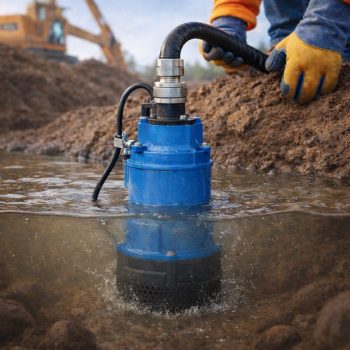
Submersible pumps are widely used across construction, mining, industrial and wastewater applications where reliable dewatering or fluid transfer is required. Designed to operate while fully submerged, they provide an efficient and durable solution for handling water, slurry and debris in demanding environments.
Understanding how these pumps function, along with key operational considerations such as motor cooling and water levels, is essential for ensuring safe and effective use.
How Submersible Pumps Work
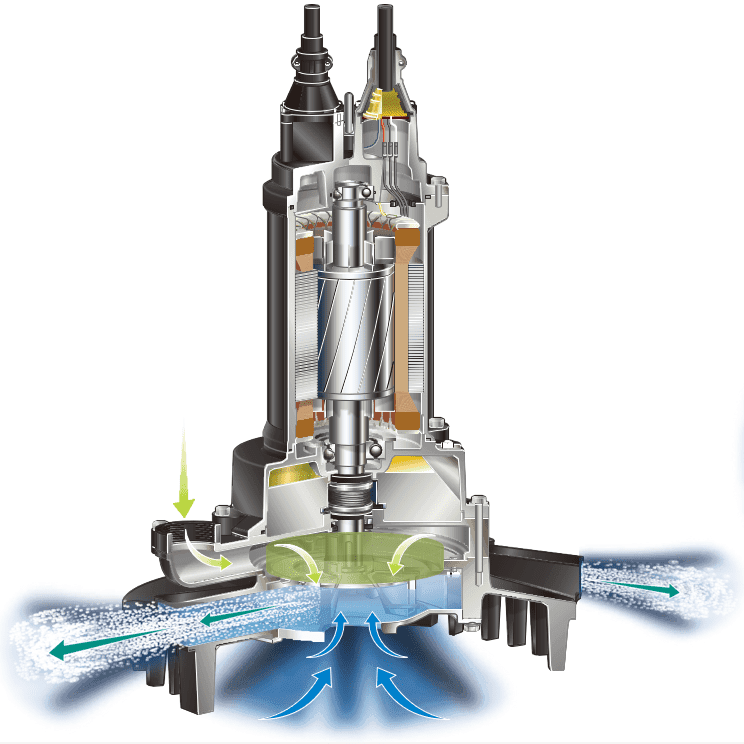
A submersible pump operates by converting the rotational energy of an electric motor into kinetic energy to move fluid.
The motor is housed within a sealed, watertight chamber to prevent liquid ingress and protect internal components. When the pump is energised, the motor drives the impeller, which rotates within the pump casing.
This rotation generates pressure, drawing fluid into the pump through the intake and forcing it upward through the discharge.
Unlike surface-mounted pumps that rely on suction, submersible pumps push fluid to the surface. This method is inherently more efficient because it avoids the energy losses associated with lifting water by suction.
Key Components

Submersible pumps consist of several integrated components that work together to ensure reliable operation:
- Motor – Fully sealed unit providing the driving force
- Impeller – Rotating element responsible for fluid movement
- Pump casing and strainer – Directs flow and prevents large debris ingress
- Mechanical seal – Prevents water from entering the motor chamber
- Bearings – Support stable rotation under load for rotor and shaft
- Stator – Generates the electromagnetic field for motor operation
- Oil lifter – Assists in lubrication of mechanical seal, and internal cooling
- Motor frame – Provides structural integrity
- Discharge – Outlet for pumped fluid
- Cable entry – Power supply sealed connection protecting internals from water damage
The durability of these components is critical, particularly in abrasive or high-demand applications. Learn more about Tsurumi pump features.
Motor Cooling Considerations
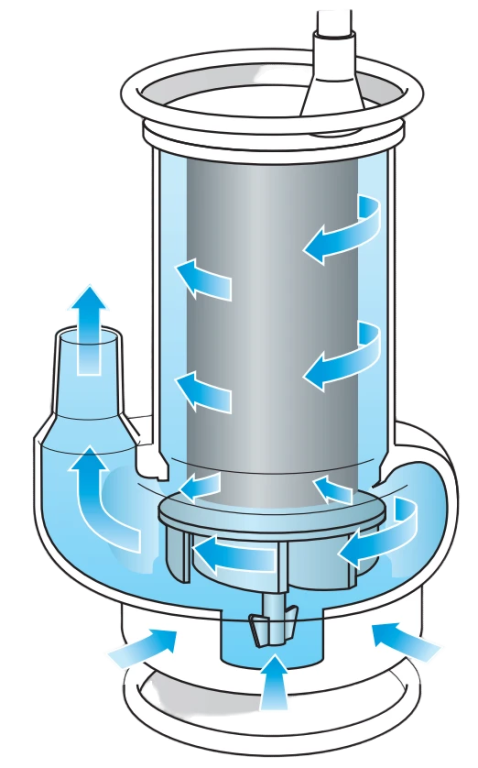
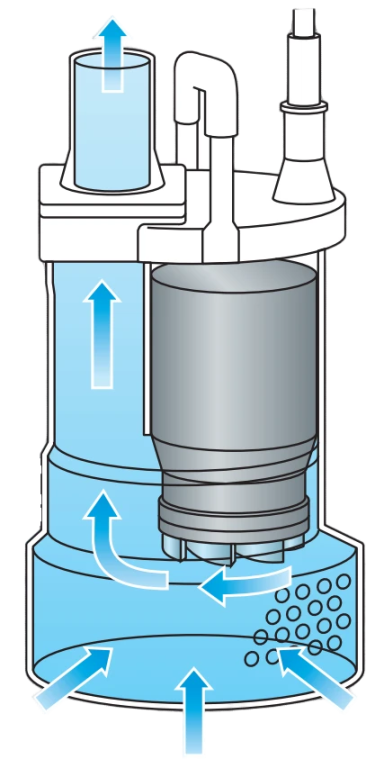
Effective motor cooling is a key factor in submersible pump performance and longevity.
In standard designs, the surrounding liquid assists with heat dissipation. However, where water levels fluctuate or drop, this cooling effect can be reduced.
To address this, some pumps incorporate a water-jacket system that circulates fluid around the motor to maintain cooling even when the pump is not fully submerged.
Selecting the appropriate cooling design is important, particularly in applications where consistent water levels cannot be guaranteed.
Continuous Water Level (C.W.L.)
Each submersible pump is designed to operate within a specified Continuous Water Level (C.W.L.), which indicates the minimum depth required for ongoing operation.
While pumps may be capable of operating at a lower water level (L.W.L.) for short periods, continuous operation below the recommended level can result in overheating and premature wear.
For this reason, it is important to follow manufacturer guidelines and ensure the pump is installed in conditions that support adequate cooling and performance.
Operational Benefits
Submersible pumps offer several practical advantages across a range of applications:
- High efficiency due to pushing fluid rather than drawing it via suction
- No priming required, allowing immediate start-up
- Reduced risk of cavitation, improving operational reliability
- Automatic operation options, including float switches or electrodes to prevent dry running
- Versatility, suitable for construction, mining, industrial and wastewater use
- Compact design, enabling installation in confined spaces such as narrow pits or pipes
- Low noise levels, as the operation occurs below the surface
- Capability for deep applications, with some models suitable for depths of up to 30 metres
Conclusion
 Submersible pumps provide an efficient and robust solution for fluid handling in challenging environments. Their ability to operate submerged, combined with simplified start-up and reliable performance, makes them a preferred choice across many industries.
By understanding how these pumps function, along with key factors such as motor cooling and continuous water levels, operators can ensure optimal performance and extend equipment lifespan.