Selecting the correct pump for a specific application requires more than simply choosing a pump capable of delivering the required flow. Understanding how a pump will perform within a particular system is essential to ensuring efficient and reliable operation.
Pump performance curves provide critical information about how a pump behaves under different operating conditions. By correctly interpreting these curves, engineers and operators can determine whether a pump will operate efficiently at the required duty point and avoid common issues such as excessive wear, vibration, and premature failure.
Understanding how flow rate, head pressure, and efficiency interact allows pumps to be selected and operated within their optimal performance range.
What Is a Pump Performance Curve?
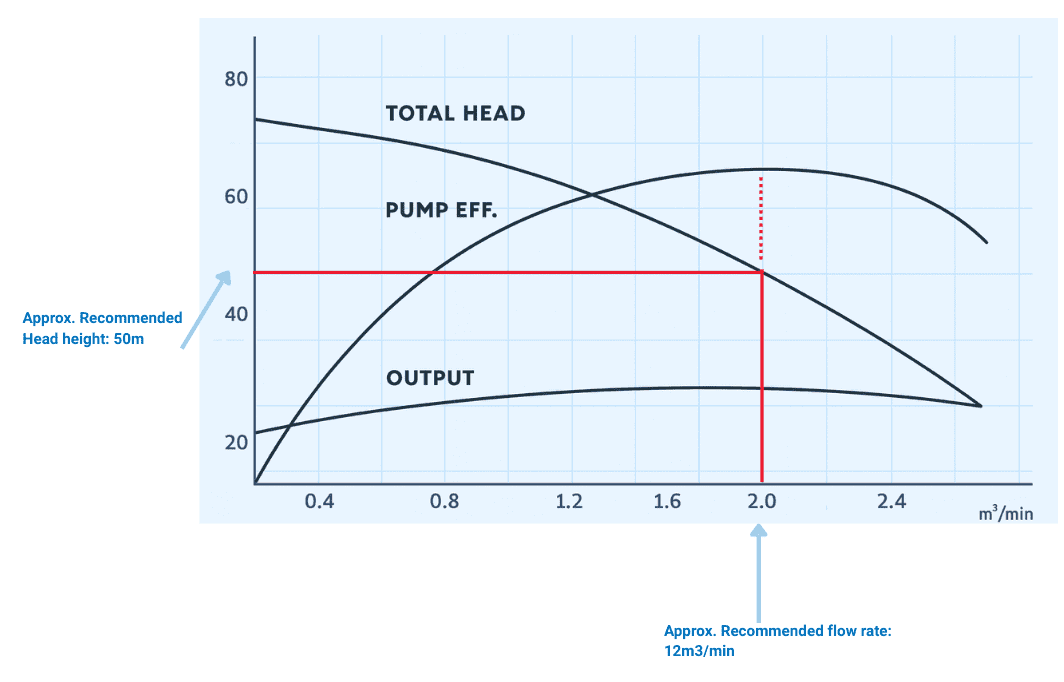
A pump performance curve illustrates the relationship between flow rate and head pressure for a specific pump model. The curve shows how much pressure the pump can generate at different flow rates and helps determine whether a pump is suitable for a particular system.
Typically, the curve begins at the shut-off head, where flow is zero and the pump produces its maximum pressure. As the head gradually decreases, the flow increases until the end of the curve is reached.
Because flow and head are directly linked, changing one will always affect the other. A pump cannot generate pressure unless the system creates resistance, which may come from vertical lift (static head) or friction losses within the pipework.
For this reason, pump performance cannot be accurately estimated without understanding the full characteristics of the system in which the pump will operate.
The following video provides a useful visual explanation of how pump curves work and how the Best Efficiency Point affects pump performance.
Understanding the Duty Point
Before selecting a pump, it is essential to determine the duty point, which defines the system’s required operating conditions. The duty point consists of two key parameters:
Flow rate – the volume of fluid that needs to be moved within a specific time period.
Total Dynamic Head (TDH) – the total pressure required to move that fluid through the system.
Total dynamic head is made up of two main components:
Static head: the vertical distance the fluid must be lifted.
Friction loss head: resistance created by pipes, valves, fittings, and other system components.
Once the duty point is calculated, it can be plotted on the pump curve to determine whether the pump will operate efficiently at that operating condition.
Accurately identifying the duty point is one of the most important steps in pump selection. Without this information, the pump may operate inefficiently or experience increased mechanical stress.
The Best Efficiency Point (BEP)
The Best Efficiency Point (BEP) is the point on the pump curve where the pump operates at its highest hydraulic efficiency. At this point, the power delivered by the pump is closest to the power supplied by the motor, meaning the pump moves the most fluid with the least energy.
In addition to efficiency, the BEP is the point at which internal hydraulic forces within the pump are balanced. Pressure and velocity around the impeller are evenly distributed, allowing the pump to operate smoothly and reliably.
For most pumps, the ideal operating range lies in the middle of the pump curve, where performance remains stable, and efficiency is highest.
Selecting a pump that operates close to the BEP under normal operating conditions helps maximise energy efficiency and extend equipment life.
Consequences of Operating Away from the BEP
Operating a pump significantly away from its BEP can introduce several mechanical and hydraulic problems. As the operating point moves further from the BEP, internal pressures around the impeller become uneven.
This imbalance creates radial thrust, which places additional load on critical components such as bearings, mechanical seals, and the pump shaft.
Common issues associated with operating outside the optimal range include:
- Increased vibration
- Excessive bearing loads
- Mechanical seal wear
- Shaft deflection
- Higher operating temperatures
In extreme cases, these conditions can lead to premature pump failure or damage to internal components.
At very low flow rates, radial load is particularly high, significantly reducing pump reliability.
Cavitation and Hydraulic Instability
Operating far outside the recommended operating range can also cause hydraulic instability in the pump. Excessive turbulence and rapid pressure changes may lead to cavitation, where vapour bubbles form and collapse within the pump.
When these bubbles collapse, they generate intense pressure shocks that can damage pump components such as the impeller, and casing.
Over time, cavitation can cause severe erosion of internal surfaces and significantly shorten the pump’s service life.
Maintaining operation near the BEP helps minimise these conditions and ensures stable hydraulic performance.
Efficiency Loss Over Time
Even when a pump is initially selected correctly, its efficiency may decline over time due to wear and changes within the system.
Common factors that contribute to reduced pump efficiency include:
- Wear to impellers, casings, bearings, and seals
- Build-up of debris or mineral deposits in pipework
- Blockages within suction or discharge lines
- Dirty or contaminated lubrication oil
- Increased friction losses within the system
- Seal failures or leaks
- Inconsistent maintenance and monitoring
As wear progresses, the pump’s performance curve may shift, causing the operating point to move further away from the BEP. This can lead to higher energy consumption and reduced pumping capacity.
Regular inspection and maintenance are essential to maintaining pump efficiency throughout its operating life. Read our related articles on pump maintenance: Maintenance Tips for Submersible Pumps | Maintenance Tips for Pumps
Confirming the Actual Operating Point
To ensure a pump continues to operate within its intended range, it is good practice to confirm the actual operating point during operation.
This can be achieved by measuring system flow rates and pressures using appropriate instrumentation, such as flow meters and pressure gauges.
If the pump is found to be operating outside the recommended range, adjustments can often be made by modifying system resistance, such as throttling discharge valves or installing bypass lines.
Verifying the operating point helps ensure the pump continues to operate efficiently and reduces the risk of long-term mechanical damage.
Conclusion
Understanding pump curves and the Best Efficiency Point is essential for selecting and operating pumps efficiently. By accurately determining the duty point and ensuring pumps operate within their optimal range, operators can improve energy efficiency, reduce mechanical stress, and extend equipment life.
Pump curves provide valuable insight into how pumps will perform under different conditions, helping engineers match pump performance with system requirements.
Through careful selection, proper installation, and ongoing maintenance, pumps can continue to operate reliably and maintain optimal efficiency throughout their operational lifespan.